The Kingdom of God Will Be Given to Those Who Bear Its Fruits
Dear brothers and sisters in Christ,
Today’s readings speak to us about God’s care, our responsibility, and the fruits that God expects from our lives.
In the first reading, Isaiah presents the beautiful image of a vineyard carefully prepared by its owner. The owner does everything necessary for the vineyard to produce good grapes, yet it produces wild grapes.
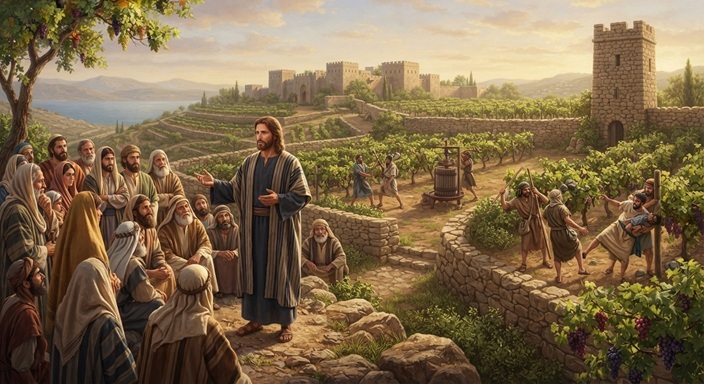
In the Gospel, Jesus uses the same image of a vineyard. A landowner plants a vineyard, prepares it carefully, leases it to tenants, and expects them to give him the fruits at harvest time. Instead, the tenants reject his servants and eventually kill his son.
The message is clear: God has entrusted His gifts to us, and He expects us to produce good fruit with what He has given us.
1. God Has Carefully Prepared His Vineyard
Isaiah says:
“My beloved had a vineyard on a very fertile hill.”
The owner did not neglect his vineyard.
He dug it, cleared it of stones, planted it with choice vines, built a watchtower, and prepared a wine vat.
Everything was done with care.
This reminds us that God has also given us many things: life, abilities, opportunities, relationships, responsibilities, and His grace.
God does not simply give us gifts and abandon us.
He continually cares for us.
The question is: What are we producing with what God has given us?
2. God Looks for Good Fruit
Isaiah says:
“He expected it to yield grapes, but it yielded wild grapes.”
The owner expected something from his vineyard.
In the Gospel, the landowner also sends servants to collect the produce from the vineyard.
This teaches us that God's gifts come with responsibility.
If God has given us a family, how are we caring for that family?
If He has given us children, how are we raising them?
If He has given us authority, how are we using it?
If He has given us talents, are we using them for good?
If He has given us opportunities to serve others, are we using them?
God does not ask us to produce what He has not given us. But He does expect us to make good use of what He has entrusted to us.
3. The Vineyard Belongs to God
The tenants in the Gospel behaved as though the vineyard belonged to them.
When the owner's servants came to collect the produce, they attacked them.
Finally, the landowner sent his son, saying:
“They will respect my son.”
But the tenants said:
“This is the heir; come, let us kill him and get his inheritance.”
Their great mistake was that they forgot that they were tenants, not owners.
This is an important lesson for us.
Everything we have ultimately comes from God.
Our life belongs to God.
Our gifts belong to God.
Our possessions belong to God.
Even our time is a gift from God.
We are stewards of these things.
Therefore, we should never live as though everything belongs entirely to us and we have no responsibility before God.
4. God Sends His Servants to Call Us Back
The landowner repeatedly sends servants to the tenants.
They reject some and kill others.
This shows God's patience.
God continues to call His people back to Himself.
He does not immediately abandon them when they fail.
He gives opportunities to change.
The Gospel shows us the seriousness of repeatedly rejecting God's call.
When God reminds us through His word, through our responsibilities, or through the circumstances of our lives, we should not continually harden our hearts.
God's patience should lead us to conversion.
5. The Son Is Rejected
Eventually, the landowner sends his son.
The tenants kill him.
Jesus asks the religious leaders:
“What will the owner of the vineyard do to those tenants?”
They answer that the owner will put those wicked tenants to a miserable death and lease the vineyard to others who will give him the produce at the harvest.
Jesus then applies the parable to Himself:
“The stone that the builders rejected has become the cornerstone.”
The Son who is rejected becomes the cornerstone.
Christ is not an optional part of God's plan.
He is the foundation.
If our lives are to produce good fruit, Christ must remain at the centre.
6. “The Kingdom of God Will Be Given to a People That Produces the Fruits of the Kingdom”
Jesus concludes:
“The kingdom of God will be given to a people that produces the fruits of the kingdom.”
Notice again the word “fruits.”
Jesus does not say that the kingdom will be given simply to those who speak about it.
He speaks of people who produce its fruits.
What are those fruits?
The second reading gives us a practical direction.
Paul tells the Philippians:
“Do not worry about anything, but in everything by prayer and supplication with thanksgiving let your requests be made known to God.”
A life rooted in God should produce prayer, thanksgiving, peace, and trust.
Paul also tells them to focus their minds on what is true, honourable, just, pure, pleasing, commendable, excellent, and worthy of praise.
These are the fruits that should be visible in our lives.
7. “Keep on Doing the Things That You Have Learned”
Paul does not only tell the Philippians what to think.
He says:
“Keep on doing the things that you have learned and received and heard and seen in me.”
Again, there is an emphasis on doing.
Christianity must be lived.
It is not enough to know what is good; we must practise it.
It is not enough to hear God's word; we must allow it to shape our lives.
It is not enough to receive God's gifts; we must use them responsibly.
The vineyard produces fruit when the tenants actually work.
Our faith produces fruit when we put God's word into practice.
8. What Kind of Fruit Are We Producing?
The first reading asks us to examine the fruit of our lives.
God has planted us in His vineyard.
He has cared for us.
He has given us opportunities.
He has surrounded us with people.
He has given us responsibilities.
What does He find when He looks at our lives?
Does He find love or hatred?
Peace or constant conflict?
Generosity or selfishness?
Faithfulness or dishonesty?
Humility or pride?
Service or exploitation?
Good fruit or wild grapes?
This is not a question only for other people.
It is a question for every one of us.
9. “Whatever Is True, Honourable, Just and Pure”
Paul gives us a beautiful standard for Christian living:
“Whatever is true, whatever is honourable, whatever is just, whatever is pure, whatever is pleasing, whatever is commendable, if there is any excellence and if there is anything worthy of praise, think about these things.”
Our thoughts influence our actions.
If we constantly nourish hatred, envy, greed, dishonesty, and resentment, those things eventually appear in our lives.
But if we allow our minds to dwell on what is true, just, pure, and good, our lives can begin to produce corresponding fruits.
The vineyard produces according to what is planted and cultivated.
We too must carefully cultivate our hearts.
10. We Are Stewards, Not Owners
The greatest lesson of the vineyard is that we are stewards of what God has entrusted to us.
The tenants were entrusted with the vineyard, but they behaved as though it belonged to them.
We can make the same mistake.
We may think our position belongs to us.
Our wealth belongs entirely to us.
Our talents belong entirely to us.
Our children belong entirely to us.
Our time belongs entirely to us.
But the Gospel reminds us that we are accountable to God.
One day, the owner will come looking for the fruits.
The question will be:
What did we do with what God entrusted to us?
Conclusion
Dear brothers and sisters,
The image of the vineyard runs through today's readings.
In Isaiah, God prepares the vineyard and expects good grapes.
In the Gospel, the landowner entrusts the vineyard to tenants and expects them to give him its fruits.
In the second reading, Paul teaches us how to cultivate our minds and lives in what is true, honourable, just, pure, pleasing, and commendable.
The message is simple:
God has entrusted something to each of us, and He expects us to bear good fruit.
Let us not be like the tenants who forgot that the vineyard belonged to the owner.
Let us remember that our lives are gifts from God and that we are called to use those gifts faithfully.
Let us ask ourselves:
What fruit is my life producing?
What does God find when He looks at my vineyard?
Am I using what He has entrusted to me for His glory and for the good of others?
May Christ, the rejected stone who has become the cornerstone, remain the foundation of our lives.
And may our lives produce the fruits that God desires.
“The kingdom of God will be given to a people that produces the fruits of the kingdom.”
Amen.