My Ways Are Not Your Ways.
Dear brothers and sisters in Christ,
Today's readings challenge the way we normally think about justice, generosity and God's ways.
In the first reading, the prophet Isaiah tells us:
“For my thoughts are not your thoughts, nor are your ways my ways, says the Lord.”
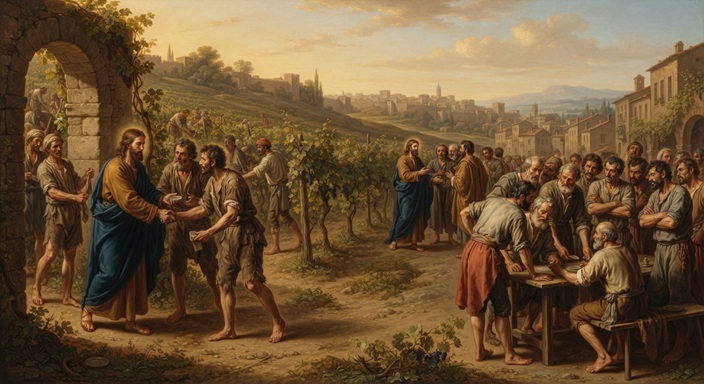
Then, in the Gospel, Jesus gives us the parable of workers in a vineyard.
Some workers begin early in the morning.
Others come at midday.
Others come at the very last hour.
Yet when the day ends, the landowner gives them all the same daily wage.
Those who worked from the beginning become unhappy.
But the landowner responds:
“Are you envious because I am generous?”
This parable teaches us that God's generosity does not operate according to our human calculations.
1. “My Thoughts Are Not Your Thoughts”
The first reading begins with a call:
“Seek the Lord while he may be found, call him while he is near.”
God invites us to return to Him.
But then He reminds us that His ways are higher than ours.
“For my thoughts are not your thoughts, nor are your ways my ways.”
We often try to understand God according to human standards.
We think:
“If I have done more, I should receive more.”
“If someone came later, they should receive less.”
“If I have sacrificed more, God should reward me more.”
But God is not limited by our calculations.
His mercy is greater than our expectations.
His generosity is greater than our measurements.
2. The Workers in the Vineyard
Jesus tells us about a landowner who goes out early in the morning to hire workers.
He agrees with the first group to pay them the usual daily wage.
Later, he goes out again and hires more workers.
He does the same at midday.
He goes out again in the afternoon.
And even at the eleventh hour, he finds people standing idle and sends them into his vineyard.
At the end of the day, he pays them.
Those who came last receive the same amount as those who came first.
This is where the problem begins.
The workers who came first feel that they deserve more.
They say:
“These last ones worked only one hour, and you have made them equal to us.”
From a purely human perspective, their complaint may seem understandable.
But Jesus is teaching us to look beyond human calculation.
3. “Are You Envious Because I Am Generous?”
The landowner answers:
“Are you envious because I am generous?”
This question goes to the heart of the parable.
The problem of the workers was not that they received less.
They received exactly what had been agreed upon.
Their problem was that someone else received generosity.
Sometimes we can behave in the same way.
We are grateful when God blesses us.
But when God blesses another person, we may become uncomfortable.
We may ask:
“Why him?”
“Why her?”
“Why did God give that person another opportunity?”
“Why did that person succeed?”
We may become envious of another person's blessings.
Today's Gospel asks us to examine our hearts.
Can we rejoice when God is generous to someone else?
4. God Is Generous
The Gospel does not present God as unjust.
Rather, it presents Him as generous.
The landowner says:
“I am doing you no wrong.”
He gives the first workers what was promised.
But he also chooses to be generous to those who came later.
This teaches us something important about God.
God's generosity is not limited by what we think people deserve.
God sees the whole person.
God sees the circumstances of each life.
God sees those who have come early.
He also sees those who have come late.
And He continues to invite people into His vineyard.
5. It Is Never Too Late to Respond to God
One beautiful aspect of the Gospel is that the landowner continues going out throughout the day.
He does not stop after the first group.
He goes again at the third hour.
Again at the sixth.
Again at the ninth.
And again at the eleventh hour.
This reminds us that God's invitation remains open.
Some people respond to God early in life.
Others come to Him later.
Some discover their faith when they are young.
Others return to God after many years.
Some people turn away and later find their way back.
The important thing is to respond when God calls.
The Gospel does not tell us to delay our response.
It reminds us that God's invitation continues to reach us.
6. “Seek the Lord While He May Be Found”
The first reading says:
“Seek the Lord while he may be found, call him while he is near.”
This is an invitation to conversion.
Isaiah tells the wicked to abandon his way and the unrighteous person his thoughts.
God invites people to return to Him.
This is important because sometimes we think:
“I will change later.”
“I will come closer to God when I am older.”
“I still have plenty of time.”
But the reading says:
“Seek the Lord while he may be found.”
When God gives us the opportunity to turn back to Him, we should not ignore it.
7. Do Not Allow Envy to Destroy Your Joy
The workers who came first had something to celebrate.
They had received their agreed wage.
But instead of celebrating, they became angry because someone else received generosity.
This is what envy can do.
It can make us forget our own blessings because we are too focused on what someone else has received.
We can have enough and still feel poor because we are constantly comparing ourselves with others.
We can be blessed and still be unhappy because someone else appears to be more blessed.
Today's Gospel teaches us:
Do not allow another person's blessing to become the reason for your unhappiness.
God's generosity toward another person does not reduce His love for you.
8. “To Me Life Is Christ”
In the second reading, St Paul says:
“Christ will be magnified in my body, whether by life or by death.”
Paul's attention is not centred on comparing himself with others.
His desire is that Christ should be glorified through his life.
He says:
“For to me life is Christ.”
This gives us another way of looking at today's Gospel.
Instead of constantly asking:
“What did the other person receive?”
we should ask:
“How can Christ be glorified through my life?”
Instead of comparing our journey with another person's journey, we should focus on faithfully following Christ.
9. “Conduct Yourselves in a Way Worthy of the Gospel”
Paul concludes the second reading by encouraging the Christians to live in a way worthy of the Gospel.
This means that our Christian life should not be controlled by jealousy, comparison or selfish ambition.
We are called to live according to the Gospel.
The workers in the vineyard were invited to work.
We too have been invited to God's vineyard.
Our task is not to compare ourselves with others.
Our task is to faithfully answer God's call.
Some may have been called earlier.
Some may have been called later.
But each person is called to respond faithfully.
Conclusion
Dear brothers and sisters,
Today's readings remind us that God's ways are greater than our ways.
The first reading tells us:
“My thoughts are not your thoughts, nor are your ways my ways.”
And Jesus asks us:
“Are you envious because I am generous?”
Let us therefore examine our hearts.
- Do I become jealous when others are blessed?
- Do I constantly compare myself with others?
- Am I grateful for what God has given me?
- Am I responding to God's call today?
- Am I willing to rejoice in God's generosity toward others?
Let us stop measuring God's goodness according to our human calculations.
Let us stop comparing our journey with the journey of others.
Let us seek the Lord while He may be found.
And let us remember that God's generosity is not something to envy.
It is something to rejoice in.
May we faithfully work in God's vineyard, trusting in His wisdom, His mercy and His generosity.
And may we always remember the words of the Lord:
“My thoughts are not your thoughts, nor are your ways my ways.”
Amen.