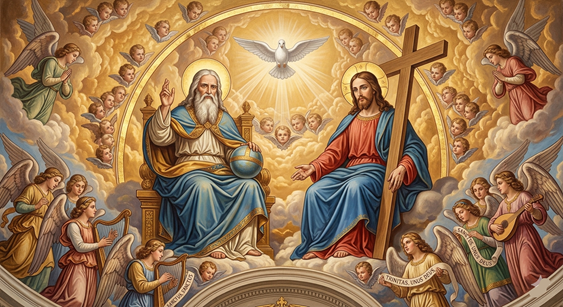
God So Loved the World.
Dear brothers and sisters in Christ,
Today we celebrate the Solemnity of the Most Holy Trinity, one of the central mysteries of our faith. While the Trinity can seem difficult to understand, today's Gospel does not present it as a complicated doctrine. Instead, it reveals the Trinity through the lens of love and salvation.
The Gospel begins with perhaps the most famous verse in the Bible:
"For God so loved the world that he gave his only Son, so that everyone who believes in him might not perish but might have eternal life."
This single verse reveals the mystery of the Trinity at work.
1. The Father: The Source of Love
The Gospel begins with God's love.
"God so loved the world..."
The Father is not distant or indifferent to human suffering. He loves the world He created. Even when humanity fell into sin, God did not abandon His people.
The Father's love is so great that He freely gives His most precious gift—His Son.
This reminds us that Christianity begins not with our love for God, but with God's love for us.
Before we ever sought Him, He sought us.
2. The Son: The Gift of Salvation
The Father sends His Son into the world.
Jesus did not come merely to teach or perform miracles. He came to save.
As the Gospel tells us:
"God did not send his Son into the world to condemn the world, but that the world might be saved through him."
Many people think of God primarily as a judge waiting to punish sinners. But Jesus reveals a God who desires salvation, mercy, and reconciliation.
The Cross is the greatest proof of that love.
Christ willingly gave His life so that we might have eternal life.
3. The Holy Spirit: The Giver of New Life
Although the Holy Spirit is not mentioned explicitly in today's short Gospel passage, the Spirit is the one who makes God's saving work effective in our lives.
The Holy Spirit:
- opens our hearts to believe,
- strengthens our faith,
- helps us live as children of God.
The Father sends the Son, and the Holy Spirit helps us receive the Son and live in His grace.
Thus, the entire Trinity is involved in our salvation.
4. God's Love Demands a Response
Jesus says:
"Whoever believes in him will not be condemned."
Faith is more than knowing facts about Jesus. It means entrusting our lives to Him.
To believe means:
- to trust His promises,
- to follow His teachings,
- to live according to His Gospel.
God offers His love freely, but He respects our freedom to accept or reject it.
5. Living the Trinity in Daily Life
The Trinity is not merely a doctrine to study; it is a relationship into which we are invited.
Every time we:
- make the Sign of the Cross,
- celebrate the Eucharist,
- pray to God,
we enter into the life of the Father, the Son, and the Holy Spirit.
The Trinity also teaches us how to live:
- in love rather than selfishness,
- in unity rather than division,
- in self-giving rather than self-seeking.
Conclusion
Dear friends,
The message of today's feast is simple yet profound:
God loves us.
The Father loved us enough to send His Son.
The Son loved us enough to give His life.
The Holy Spirit loves us enough to dwell within us.
As we celebrate the mystery of the Most Holy Trinity, let us open our hearts to that divine love and allow it to transform our lives.
May we never forget that we are loved by the Father, saved by the Son, and guided by the Holy Spirit.
Amen.